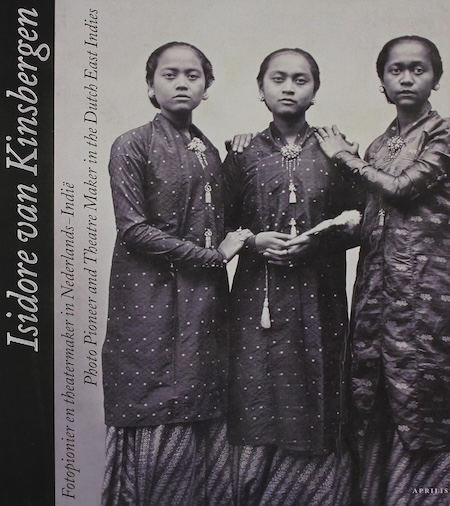
KINSBERGEN~Isidore van (1821 – 1901), Fotopionier en theatermaker in Nederlands-Indië*
€20,00
Author: Theuns - de Boer~Gerda
Publisher: Uitgeverij Aprilis, Zaltbommel
Year: 2005
ISBN: 90 5994 117 9

Hardcover, 296 pages, Dutch, 24 x 28 cm
Condition: very good

Isidore van Kinsbergen is wel getypeerd als de sleeping beauty van de 19de-eeuwse fotografie. Hoewel hij al tijdens zijn leven grote roem vergaarde en ook internationaal bekend was, is er nog nooit een grote overzichtstentoonstelling aan zijn oeuvre gewijd. Dat terwijl Isidore van Kinsbergen een flamboyante, tot de verbeelding sprekende kunstenaar is, die zijn ervaringen als theatermaker volop in zijn fotografie benutte. De tentoonstelling presenteert ruim 140 foto's, albums en andere objecten uit verschillende collecties in binnen- en buitenland. Deze geven voor het eerst een breed beeld van de bijzondere kwaliteiten van deze fotopionier. Van Kinsbergens contacten in de hoogste bestuurlijke kringen in Nederlands-Indi??? leverden hem bijzondere foto-opdrachten op. Dankzij zijn onvermoeibare inzet voor nieuwe culturele projecten werd hij ook wel de ziel van het koloniale artistieke leven in Batavia genoemd.
Isidore van Kinsbergen werd geboren in 1821 te Brugge als zoon van een Zuid-Nederlandse moeder en Amsterdamse vader. In 1851 vertrok hij naar Batavia waar hij zich eerst als lithograaf, decorschilder en theatermaker en vanaf ca. 1860 ook als fotograaf vestigde. In 1862 reisde hij als wetenschappelijk fotograaf mee met het Nederlandse gezantschap naar het hof van Siam (Thailand), waar hij in Bangkok verschillende monumenten op aansprekende wijze fotografeerde. Beroemd is Van Kinsbergen geworden met de bijna 400 foto's die hij in opdracht van het Nederlandse gouvernement en het Bataviaasch Genootschap maakte van oudheden op Java. Hieronder bevinden zich tempels op het Diengplateau, Prambanan, Candi Panataran en de wereldberoemde Borobudur. Deze foto's brachten Nederlandse auteurs als P.J. Veth en Conrad Busken Huet in extase en inspireerden de Franse kunstenaar Paul Gauguin. Daarnaast hebben deze foto's de basis gelegd voor de kennismaking met de klassieke Indonesische kunst en het onderzoek naar deze oudheden gestimuleerd.

Uitvoerig onderzoek heeft ook een tot nu toe onbekend deel van Van Kinsbergens oeuvre aan het licht gebracht. Zo is er een ruime selectie te zien uit de portretten die Van Kinsbergen tussen 1862 en 1865 maakte, toen hij in het gevolg van de gouverneur-generaal op bezoek was bij de vorsten van Yogyakarta, Surakarta, Bandung, Madura en Buleleng (Bali). De expressieve manier waarop hij in zijn studio mensen uit verschillende sociale lagen in Batavia portretteerde, laat zien hoe hij in de fotostudio zijn ervaringen als theaterregisseur gebruikte.

Een tentoonstelling van Van Kinsbergen vereist multidisciplinair onderzoek. Dat is uitgevoerd door de indologe Gerda Theuns-de Boer, tevens medewerker fotografiecollectie van Instituut Kern in Leiden. De tentoonstelling en publicatie kwamen tot stand in nauwe samenwerking met Saskia Asser, conservator van Huis Marseille. Het symposium dat het International Institute for Asian Studies in oktober 2004 te Leiden organiseerde, bracht nieuwe inzichten over Van Kinsbergen aan het licht. Daarnaast leverde het onderzoek voortdurende nieuwe vondsten op in Nederland ???n Indonesi???. Zo werden op de valreep in augustus 2005 Van Kinsbergens originele negatieven, in vrijwel ongeschonden staat, getraceerd in het depot van de afdeling geschiedenis en archeologie van het Indonesiche Ministerie van Cultuur en Toerisme (het is nog niet bekend of deze ook op de tentoonstelling te zien zullen zijn). Daarnaast is in de tentoonstelling een ruime selectie te zien uit de bijzondere nalatenschap van H.J. Ankersmit uit de collectie van het KIT Tropenmuseum, de andere helft van deze nalatenschap is enkele maanden geleden gevonden in het Rijksmuseum te Amsterdam.

De gelijknamige tentoonstelling in Huis Marseille - Amsterdam en het boek zijn gerealiseerd in samenwerking met het Koninklijk Instituut voor Taal-, Land- en Volkenkunde (Leiden), Rijksmuseum voor Volkenkunde (Leiden), KIT Tropenmuseum (Amsterdam), Instituut Kern (Leiden), Koninklijk Huisarchief (Den Haag), Prentenkabinet Universiteit Leiden, Biblioth???que nationale de France (Parijs), Wereldmuseum (Rotterdam), International Institute for Asian Studies (Leiden) en diverse particuliere verzamelaars uit binnen- en buitenland.
Isidore van Kinsbergen has been described as the sleeping beauty of 19th-century photography. Although he achieved great fame during his lifetime and was also internationally known, there has never been a major retrospective exhibition dedicated to his oeuvre. And yet Isidore van Kinsbergen is a flamboyant, imaginative artist who made full use of his experiences as a theatre maker in his photography. The exhibition presents over 140 photos, albums and other objects from various collections at home and abroad. For the first time, these provide a broad picture of the special qualities of this photo pioneer. Van Kinsbergen's contacts in the highest administrative circles in the Dutch East Indies provided him with special photo assignments. Thanks to his tireless efforts for new cultural projects, he was also called the soul of colonial artistic life in Batavia.
Isidore van Kinsbergen was born in 1821 in Bruges as the son of a mother from the South of the Netherlands and a father from Amsterdam. In 1851 he left for Batavia where he first established himself as a lithographer, set painter and theatre maker and from around 1860 also as a photographer. In 1862 he travelled as a scientific photographer with the Dutch embassy to the court of Siam (Thailand), where he photographed various monuments in Bangkok in an appealing way. Van Kinsbergen became famous for the almost 400 photos he made on behalf of the Dutch government and the Bataviaasch Genootschap of antiquities on Java. These include temples on the Dieng Plateau, Prambanan, Candi Panataran and the world-famous Borobudur. These photos brought Dutch authors such as P.J. Veth and Conrad Busken Huet into ecstasy and inspired the French artist Paul Gauguin. In addition, these photos laid the foundation for the introduction to classical Indonesian art and stimulated research into these antiquities.

Extensive research has also brought to light a previously unknown part of Van Kinsbergen's oeuvre. For example, a large selection of the portraits that Van Kinsbergen made between 1862 and 1865, when he was in the entourage of the governor-general visiting the princes of Yogyakarta, Surakarta, Bandung, Madura and Buleleng (Bali), can be seen. The expressive way in which he portrayed people from different social classes in Batavia in his studio shows how he used his experiences as a theatre director in the photo studio.

An exhibition of Van Kinsbergen requires multidisciplinary research. This was carried out by Indologist Gerda Theuns-de Boer, who is also a staff member of the photography collection at the Kern Institute in Leiden. The exhibition and publication were created in close collaboration with Saskia Asser, curator of Huis Marseille. The symposium that the International Institute for Asian Studies organised in Leiden in October 2004 brought new insights into Van Kinsbergen to light. In addition, the research continually yielded new discoveries in the Netherlands and Indonesia. For example, at the last minute in August 2005, Van Kinsbergen's original negatives, in virtually undamaged condition, were traced to the depot of the history and archaeology department of the Indonesian Ministry of Culture and Tourism (it is not yet known whether these will also be on display at the exhibition). In addition, the exhibition features a large selection from the special legacy of H.J. Ankersmit from the collection of the KIT Tropenmuseum, the other half of this legacy was found a few months ago in the Rijksmuseum in Amsterdam.

The exhibition of the same name in Huis Marseille - Amsterdam and the book were realised in collaboration with the Royal Netherlands Institute of Southeast Asian and Caribbean Studies (Leiden), the National Museum of Ethnology (Leiden), the KIT Tropenmuseum (Amsterdam), the Kern Institute (Leiden), the Royal House Archives (The Hague), the Print Room of Leiden University, the Bibliothèque nationale de France (Paris), the Wereldmuseum (Rotterdam), the International Institute for Asian Studies (Leiden) and various private collectors from the Netherlands and abroad.
Out of stock